Change Country

-or-


This is part 1 of a 3-part leadership series on Operational Excellence.
By John Ryan
When leaders talk about Operational Excellence, it is often framed as a set of tools, a training programme or a continuous improvement initiative that sits alongside the day‑to‑day running of the business. When it is positioned that way, it is not surprising that it struggles to gain traction or sustain momentum.
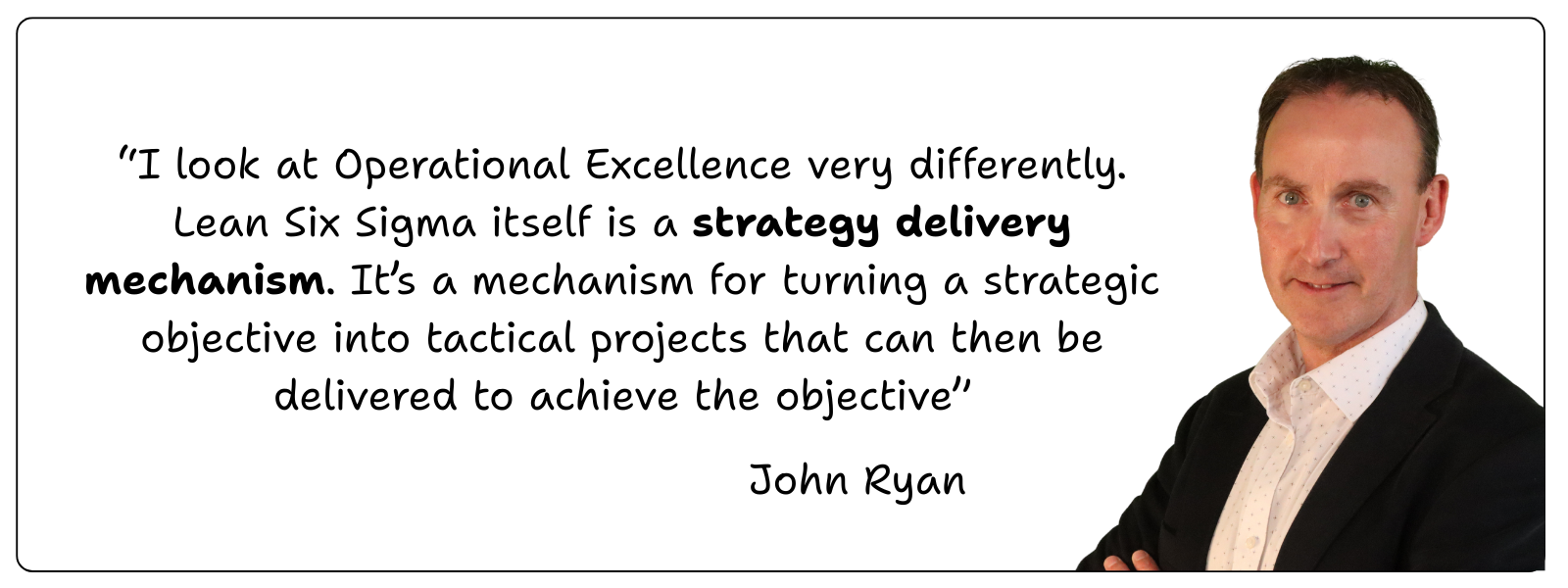 Quote Strategy delivery Mechanism
That distinction matters. Because when Operational Excellence is treated as a toolkit or a training initiative, it tends to generate activity without impact. When it is treated as a strategy delivery mechanism, it becomes a practical way for leaders to translate intent into results.
One of the most common mistakes I see organisations make is jumping straight to training before stepping back to ask a more fundamental leadership question: what do we actually want from Operational Excellence?
In practice, organisations are usually looking for one or more of three things.
They may want to develop capability by building structured problem‑solving skills. They may want to deliver results by targeting strategic priorities and translating them into projects. Or they may want to drive engagement and culture by moving people away from firefighting and towards more structured thinking.
All three are valid. The challenge arises when leaders do not make this explicit. Different objectives require different choices around projects, people and governance. Without that clarity, Operational Excellence becomes a collection of disconnected activities rather than a coherent delivery system.
Another reason Operational Excellence programmes struggle is that many organisational strategies are written as aspirations rather than something that can be measured and executed. They may be clear on direction but vague on outcomes.
The strategies that work better are the ones that are specific and measurable. When there is a clear strategic objective and an agreed metric, it becomes much easier to identify the work that will actually move that metric.
This is where Operational Excellence plays a key role. Strategic objectives are typically expressed as business‑level measures such as customer satisfaction, revenue, or cost. OpEx projects focus on operational measures such as on-time delivery, cycle time, or rework. The discipline of Operational Excellence links the two, translating strategy into operational delivery.
Leaders often ask where to start. While a crisis can sharpen focus, it is not a prerequisite.
In my experience, the most effective starting point is the annual planning cycle. When organisations are planning the year ahead, that is the right moment to decide what matters most and how Operational Excellence will support delivery of those objectives.
This approach ensures OpEx work is aligned with real business priorities. It also creates opportunities to develop capability in the next layer of leaders by giving them responsibility for meaningful and visible projects. Over time, this is why well‑designed OpEx programmes support both performance and leadership development.
Another leadership trap is trying to solve large strategic problems with a single oversized project. To give projects a realistic chance of success, they need to be tightly scoped.
As I put it in the interview, trying to do everything at once is “trying to eat the whole elephant in one go.”
A more effective approach is to start with a topic and build a portfolio of smaller projects that collectively deliver a larger objective. For example, an organisation may decide it wants to speed up a core process. That can lead to an end‑to‑end view through value stream mapping, followed by several focused projects targeting bottlenecks, delays or rework. This wave approach allows leaders to manage delivery while still making progress against strategic goals.
If Operational Excellence is a strategy delivery mechanism, it needs to be led like one. That means clear ownership and governance.
Sustainable programmes typically have one person accountable for driving Operational Excellence, supported by a senior leadership group that helps set direction, reinforce priorities and recognise success. Sponsors, usually process owners, play a critical role in shaping projects, supporting delivery and enabling implementation.
When these roles are clear, Operational Excellence has a system behind it. When they are not, it becomes something people attempt to do alongside already full workloads.
At its core, Operational Excellence is not about tools. It is about how organisations think, decide and act. It gives leaders a structured way to move from strategy to delivery and away from constant firefighting.
When leaders treat Operational Excellence as a strategy delivery mechanism rather than a toolkit, it becomes part of how the organisation executes its strategy.

Opex as a Delivery Mechanism
At SQT, we work with leaders on the basis that Operational Excellence only delivers value when it is designed and led as a system, not introduced as training alone.
We are not just here to train people. Our role is to support leaders in setting up a sustainable Operational Excellence programme that aligns with strategy and delivers real outcomes.
In practice, this starts with leadership and champion‑level support. We work with leaders to help design and structure their programme, clarify objectives, select the right projects and identify the right people to lead them.
We then support delivery through the part that matters most: the project work. That includes early charter review to ensure projects are well scoped, ongoing mentoring and one‑to‑one support for project leaders and guidance through governance and phase reviews so that decisions are clear and defensible.
By combining leadership support, structured training and hands‑on mentoring, we help organisations move beyond isolated improvement activity and build Operational Excellence as a true strategy delivery mechanism.
In the next article, I will focus on the cultural side of Operational Excellence and the leadership behaviours that help organisations move away from firefighting and towards sustained, structured problem solving.
Part 2 – Operational Excellence, Leadership and Culture: Moving Beyond Firefighting
Part 3 – How Leaders Know Operational Excellence Is Working — And When It Is Not
Lean Six Sigma Yellow Belt – QQI Level 6
 Categories
 Archive
Sign up to receive the latest industry and company news direct to your inbox.
 2026
2026