Change Country

-or-


This is part 3 of a 3-part leadership series on Operational Excellence.
By John Ryan
After strategy and culture, the question leaders inevitably ask is a simple one: how do I know whether Operational Excellence is actually working?
It is a fair question. Most organisations invest significant time and effort in improvement activity. The challenge for leaders is separating genuine progress from activity that looks busy but does not stick.
In my experience, leaders often struggle with this because they look for the wrong signals.
Many organisations judge Operational Excellence by visible outputs. How many people were trained. How many projects were completed. How many presentations were delivered.
None of these are wrong, but none of them on their own tell you whether Operational Excellence is working.
You can complete projects and still have the same problems six months later. You can train large numbers of people without changing how decisions are made. You can deliver early wins that fade as soon as attention shifts.
 How We Know It’s Working
The most basic test of Operational Excellence is whether project outcomes are sustained. Improvements that hold over time indicate that teams have understood the problem, addressed root causes and implemented changes properly.
When results disappear after a few weeks or months, it usually means the solution was superficial. Something was changed, but the underlying cause was not addressed or the change was not embedded.
Sustainable results are a strong signal that people have engaged properly with the methodology and applied disciplined thinking rather than jumping to conclusions.
The stronger signals of success appear outside formal projects.
When Operational Excellence is working, you start to hear different questions being asked in everyday conversations. Instead of defaulting to actions, people begin to ask about scope, evidence and causes.
This is one of the clearest indicators leaders should pay attention to:
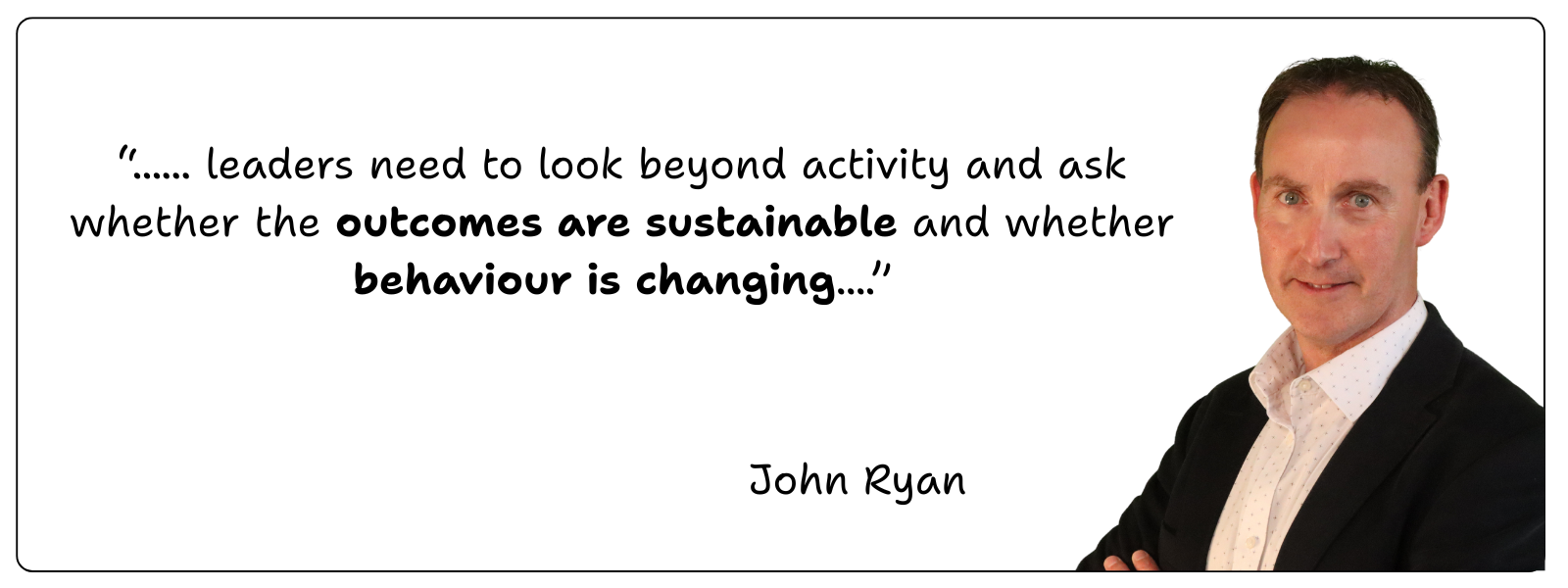
“You start to look at the expansion of the use of tools and language outside of the projects. Are people using this in their day‑to‑day? Are we starting to hear people questioning instead of just taking actions?”
When that language begins to appear naturally, it tells you Operational Excellence is becoming embedded rather than contained within projects.
One of the clearest indicators of maturity is who gets pulled into problems when pressure is on.
In organisations where Operational Excellence is working, people who have engaged with the programme tend to become the go‑to problem solvers. Leaders seek them out when issues arise because they trust their structured approach and their ability to get things done properly.
Over time, this often influences progression and development. People are recognised not because they have a belt or a certificate, but because they consistently demonstrate disciplined thinking and delivery under pressure.
That is a far more meaningful indicator than any dashboard.
There are also clear warning signs when Operational Excellence is not delivering what it should.
Projects may be completed, but the same problems keep recurring. People may disengage after early enthusiasm because nothing really changes. Operational Excellence may be seen as extra work rather than part of how work is done.
In these situations, leaders often sense that something is not right, but it is not always obvious why. In my experience, the causes are rarely technical. They are usually leadership or system issues.
There are a few patterns I see repeatedly when Operational Excellence programmes lose momentum.
The first is selecting the wrong people to lead projects. Organisations often choose very busy or very senior people because they are capable. The problem is that if people do not have the bandwidth or the interest, projects get deprioritised and delivery suffers. Bandwidth matters.
The second is having no plan beyond the first wave. Some organisations run a successful wave of projects and then stop. There is no expectation of what happens next, no progression and no mechanism to build on the capability that has been developed.
The third is loss of senior leadership attention. This is one of the most common causes of decline. As priorities shift, Operational Excellence quietly slips down the list. Resources follow attention, and without deliberate reinforcement, programmes plateau and then fade.
As I have said before, whatever the senior leadership team puts emphasis on is what gets attention and resources. Operational Excellence is no different.
Operational Excellence competes with every other strategic priority in the organisation. It does not survive on goodwill alone.
What leaders ask about, review and recognise shapes behaviour. When leaders continue to engage, ask questions and expect structured thinking, Operational Excellence stays alive. When they do not, it becomes optional.
Sustaining focus does not mean micromanaging projects. It means maintaining visibility, reinforcing expectations and making it clear that disciplined problem solving is how the organisation delivers results.
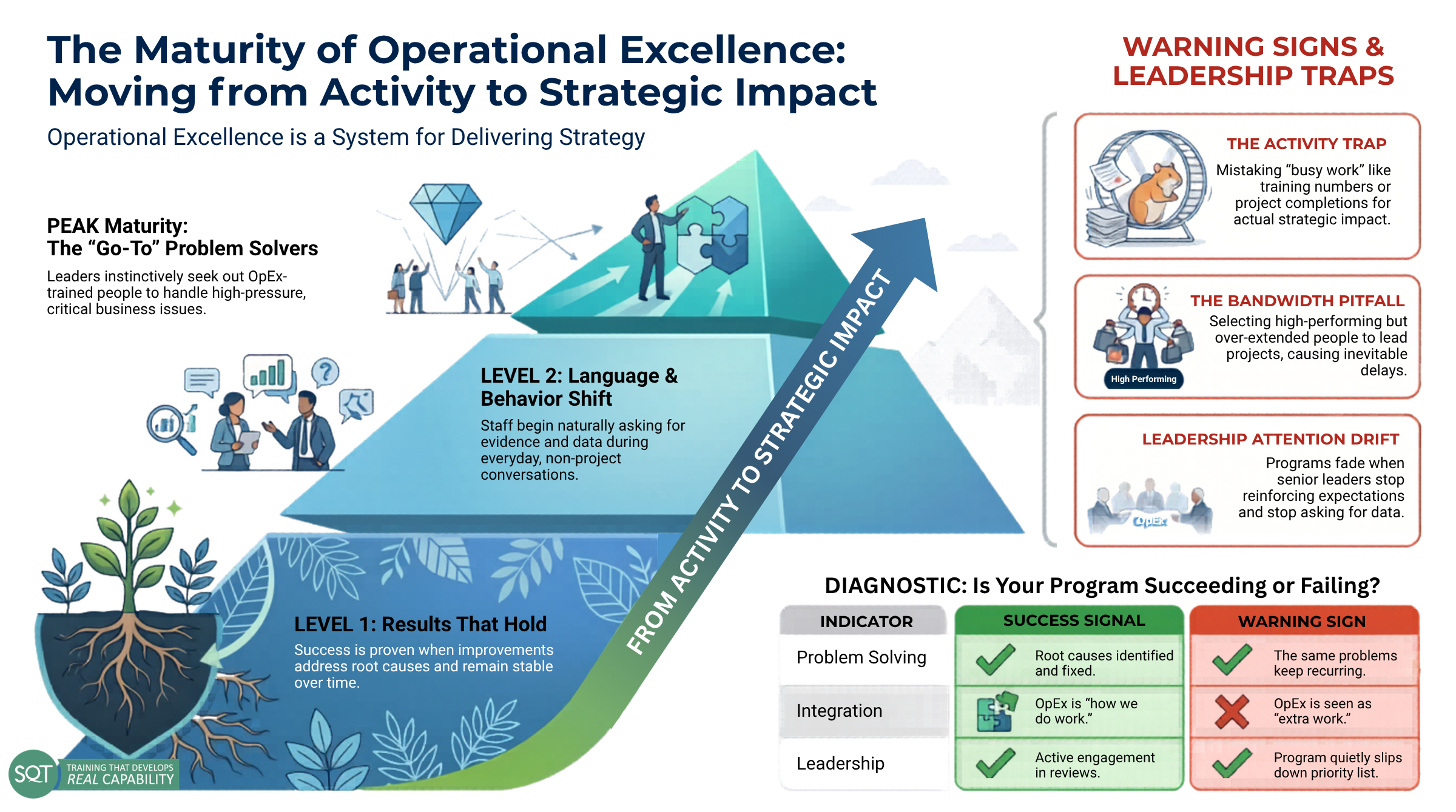 The Maturity of Operational Excellence – Moving from Activity to Strategic Impact
At SQT, we work with leaders who want Operational Excellence to last beyond the first wave of activity. Our focus is not just on training people, but on supporting leaders to design and sustain a programme that delivers over time.
This often starts with champion and leadership training. We work with leaders to clarify what success looks like, design governance that supports delivery and set expectations around sponsorship, visibility and progression.
We also support leaders in selecting the right projects and the right people, helping avoid common traps around scope, bandwidth and engagement. As delivery progresses, we provide mentoring and one‑to‑one support to help maintain discipline and momentum.
Just as importantly, we help leaders recognise when programmes are drifting and intervene early. That might mean adjusting project selection, strengthening sponsorship or re‑engaging leadership attention before momentum is lost.
Across these three articles, the message is consistent.
Operational Excellence works when leaders treat it as a system. A system for delivering strategy. A system for shaping culture. A system for building sustainable capability.
When leaders take ownership of that system, Operational Excellence becomes more than a programme. It becomes part of how the organisation thinks, decides and delivers. It becomes ‘business as usual’.
Part 1 – Operational Excellence Is a Strategy Delivery Mechanism – Not a Toolkit
Part 2 – Operational Excellence, Leadership and Culture: Moving Beyond Firefighting
Lean Six Sigma Yellow Belt – QQI Level 6
 Categories
 Archive
Sign up to receive the latest industry and company news direct to your inbox.
 2026
2026